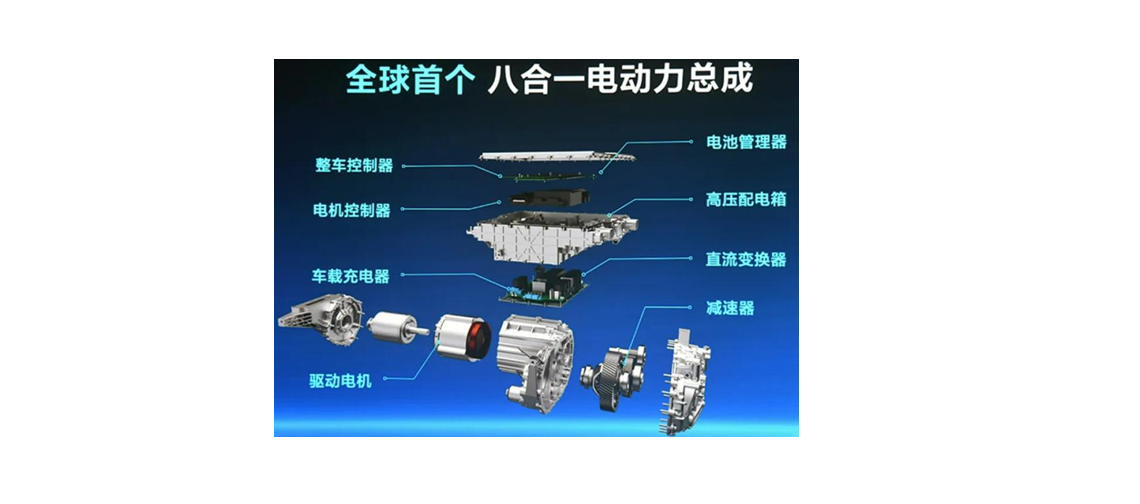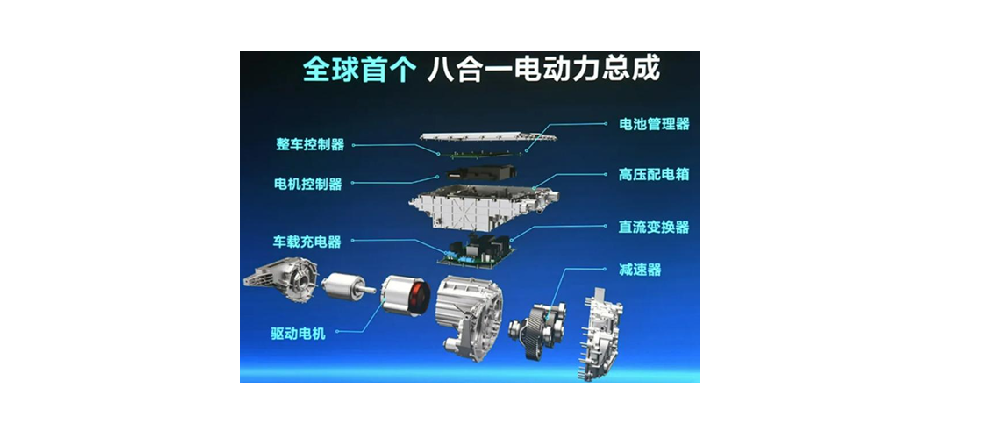
新能源汽车的动力系统与传统燃油车不同,采用了“三电”系统,取代了传统的
油箱、发动机和变速箱。所谓的“三电”包括驱动系统中的“大三电”——动
力电池、电机控制器和电机,以及电源系统中的“小三电”——车载充电机(OBC)、
DC/DC变换器和高压配电盒(PDU)。
The powertrain of new energy vehicles differs from that of traditional fuel-powered
vehicles, utilizing a "three electric" system that replaces the conventional fuel tank,
engine, and transmission. The so-called "three electric" system includes the "big
three electric" components in the drive system—the power battery, motor
controller, and electric motor—as well as the "small three electric" components in
the power supply system—the on-board charger (OBC), DC/DC converter, and
power distribution unit (PDU).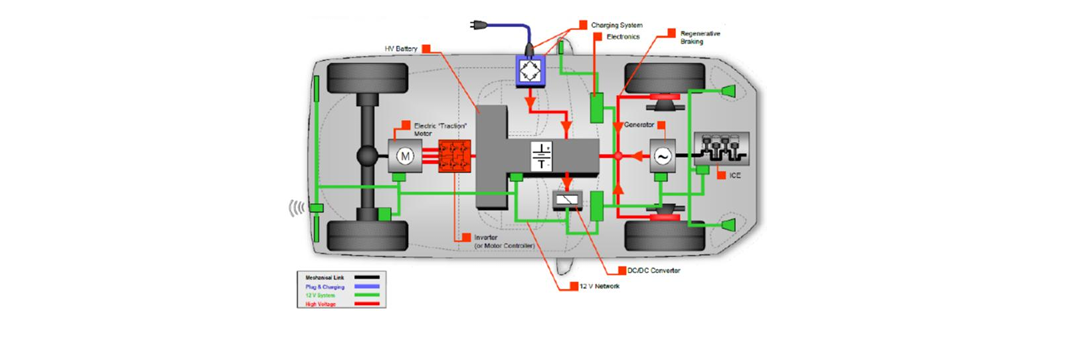 新能源汽车车载充电机(OBC)将交流充电桩的交流电转换为动力电池所需的
直流电,实现对动力电池的充电,使用交流充桩充电的新能源汽车需要搭载车载
充电机。Theon-board charger (OBC) in new energy vehicles converts AC power
from charging piles into DC power required by the traction battery, enabling the
battery to be charged. New energy vehicles that use AC charging piles must be
equipped with an on-board charger.
新能源汽车车载充电机(OBC)将交流充电桩的交流电转换为动力电池所需的
直流电,实现对动力电池的充电,使用交流充桩充电的新能源汽车需要搭载车载
充电机。Theon-board charger (OBC) in new energy vehicles converts AC power
from charging piles into DC power required by the traction battery, enabling the
battery to be charged. New energy vehicles that use AC charging piles must be
equipped with an on-board charger.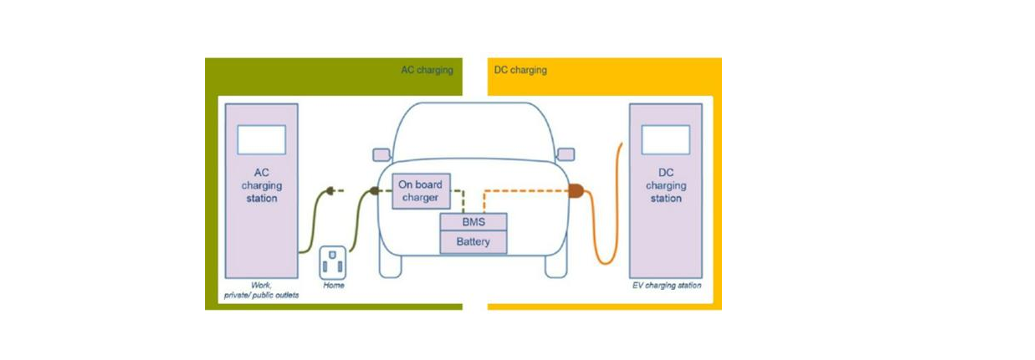
1、车载充电机类型:1.TypesofOn-BoardCharger (OBC): 1单向车载充电机(Uni-DirectionOBC):功率单向流动,通常采用高 频开关电源技术,拓扑结构有单级式和两级式结构。这种充电机仅具备充电功能。 ①Uni-directional On-Board Charger (Uni-directional OBC): This type features unidirectional power flow and typically employs high-frequency switching power supply technology, with topologies including single-stage and two-stage structures. This charger is equipped with the charging function only. 2双向车载充电机(Bi-DirectionOBC):功率双向流动,多采用两级 变换结构,由双向 AC-DC 变换器和双向 DC-DC 变换器构成;既有充电功能, 同时还有逆变功能。②BidirectionalOn-Board Charger (Bidirectional OBC): This type features bidirectional power flow and typically employs a two-stage conversion structure, composed of a bidirectional AC-DC converter and a bidirectional DC-DC converter. It is equipped with both charging and inverter functions. 充电功能:从电网取电,经由地面交流充电桩、交流充电口,连接至车 载充电机,给车载动力电池进行充电。 Charging Function: It draws electricity from the grid, which is then delivered through the ground AC charging pile and AC charging port to the on-board charger (OBC) to charge the vehicle's traction battery. 逆变功能Inverter Function: V2L(Vehicle to Load)逆变功能:从车载动力电池取电,经由双 向车载充电机、交流充电口、专用的V2L交流电插座板,给地面电气设 备提供220VAC交流电; V2L (Vehicle to Load) Inverter Function: It draws power from the vehicle's traction battery, which is then converted and supplied through the bidirectional on-board charger (OBC), AC charging port, and a dedicated V2L AC outlet adapter to provide 220V AC power for ground-based electrical equipment. V2G(Vehicle-to-grid)逆变功能:从车载动力电池取电,经由双 向车载充电机、交流充电口、地面交流充电桩,连接至电网。 V2G(Vehicle-to-Grid) Inverter Function: It draws power from the vehicle's traction battery, which is then converted and fed back through the bidirectional on-board charger (OBC), AC charging port, and ground AC charging pile to connect to the power grid. 3集成式车载充电机③IntegratedOn-BoardCharger: OBC、DC-DC、PDU等车载电源的集成:OBC+DC-DC二合一集成、 OBC+DC-DC+PDU三合一集成; Integration of vehicle power supply components (e.g., OBC, DC-DC, PDU): Includes two-in-one integration (OBC + DC-DC) and three-in-one integration (OBC + DC-DC + PDU). 电机、电控、减速器、OBC、DC-DC、BMS等电驱+车载电源的集成: 多合一集成。 Integration of electric drive system and vehicle power supply components (e.g., electric motor, motor controller, gearbox, OBC, DC-DC, BMS): Referred to as multi-in-one integration.
2. 车载充电机的发展趋势2.DevelopmentTrendsofOn-Board Chargers
目前市场主流车型搭载的车载OBC输出功率由3.3kW向6.6kW升级,车载
OBC未来向着功率等级提升尺寸小型化、双向转换和集成化的方向发展。
输出功率6.6kW的车载充电机已成国内主流趋势,正逐步升至11kW和22kW。
同时各企业研发出二合一、三合一甚至八合一集成方案,目前较优的二合一方案
为6.6kWOBC+1.5kWDC/DC,三合一为6.6kWOBC+2kWDC/DC+PDU。
The output power of mainstream on-board OBCs has been evolving from 3.3 kW t
o 6.6 kW. Future OBCs are advancing toward higher power levels, more compact d
esigns, bidirectional power conversion, and higher integration.
In China, 6.6 kW OBCs have become the mainstream standard, with a gradual shift
toward 11 kW and 22 kW systems. Meanwhile, companies have developed integr
ated solutions such as two-in-one, three-in-one, and even eight-in-one combinati
ons. Among these, a typical high-performance two-in-one configuration integrate
s a 6.6 kW OBC with a 1.5 kW DC/DC converter, while a representative three-in-on
e solution combines a 6.6 kW OBC, a 2 kW DC/DC converter, and a PDU